Nitrogen emitted in livestock manure at 2025 limit, phosphates above limits
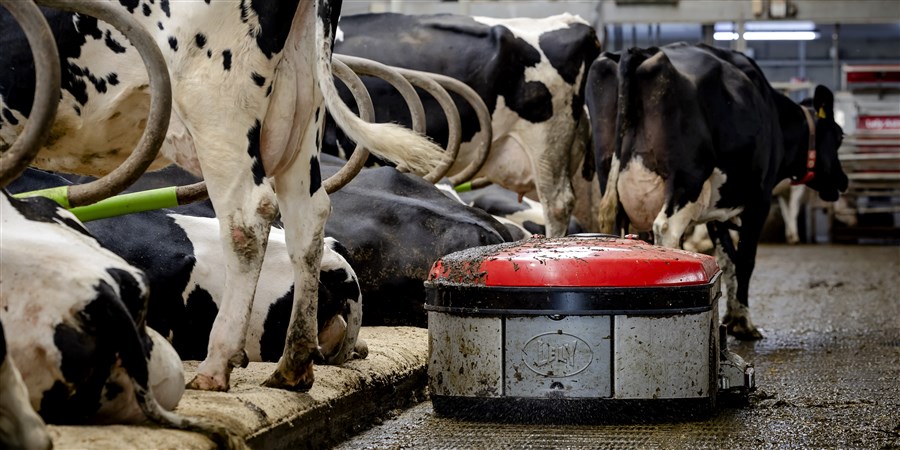
- In 2025, 2 percent less nitrogen was emitted compared with 2024. This brought nitrogen excretion in livestock manure down to the applicable limits.
- Emissions of phosphates also fell, but remained above limits.
- Nitrogen compounds and phosphates emitted in livestock manure fell across all sectors of livestock farming.
In 2025, 440 million kilograms of nitrogen compounds were emitted in livestock manure, a fall of 2 percent compared with 2024. That quantity is in line with the nitrogen emissions limit for 2025. Emissions of phosphates also fell, by 4 percent to 142 million kilograms, which is above the applicable limits for phosphates. Statistics Netherlands (CBS) reports this on the basis of provisional figures.
In 2025, the emission ceilings were reduced to 440 million kilograms of nitrogen compounds and 135 million kilograms of phosphates. To comply with these limits, emissions had to be reduced compared with 2024: by 2 percent for nitrogen compounds and 8 percent for phosphates.
| Jaar | Nitrogen compounds (million kg) | Phosphates (million kg) |
|---|---|---|
| 2015 | 497.5 | 180.0 |
| 2016 | 504.4 | 175.2 |
| 2017 | 512.1 | 169.0 |
| 2018 | 503.5 | 161.8 |
| 2019 | 489.7 | 155.5 |
| 2020 | 489.4 | 150.8 |
| 2021 | 471.0 | 148.0 |
| 2022 | 467.2 | 150.4 |
| 2023 | 463.6 | 147.5 |
| 2024 | 449.0 | 146.8 |
| 2025* | 439.5 | 141.5 |
| ¹⁾EC decision of 30 September 2022 granting derogation * provisional figures | ||
Nitrogen excretion from dairy cattle is decreasing
In 2025, nitrogen excretion in manure from cows, pigs, poultry and other livestock was in line with the nitrogen emissions limit of 440 million kilograms. Nitrogen excreted by cattle was down by 2 percent to 292 million kilograms. Dairy cattle (including young stock) excreted 260 million kg of nitrogen, i.e. 2 percent less than in 2024.After the milk quota was abolished in 2015, the Netherlands’ population of dairy cattle grew, with higher manure production as a result. Measures to reduce the population of dairy cows subsequently led to a reduction in manure production from 2017 onwards. As a result, and due to the lower nitrogen content in cattle feed, the amount of nitrogen excreted by livestock has decreased by 14 percent (72 million kilograms).
Less nitrogen excreted in pig and poultry manure
Nitrogen excreted by pigs was down by 3 percent from 2024. Excretion from poultry also decreased, by 1 percent. This is mainly because there are fewer animals in both sectors. Nitrogen excretion from other livestock (including beef cattle, horses, sheep and goats) totalled 53 million kilograms. This was also lower than in 2024.
| Jaar | Cattle (million kg) | Pigs (million kg) | Poultry (million kg) | Other livestock (million kg) |
|---|---|---|---|---|
| 2015 | 315.7 | 99.3 | 62.0 | 20.5 |
| 2016 | 327.5 | 96.9 | 62.2 | 17.8 |
| 2017 | 337.0 | 97.4 | 58.9 | 18.8 |
| 2018 | 327.4 | 96.6 | 56.8 | 22.7 |
| 2019 | 315.7 | 93.7 | 56.0 | 24.3 |
| 2020 | 320.1 | 91.8 | 54.7 | 22.8 |
| 2021 | 305.9 | 88.9 | 54.3 | 21.9 |
| 2022 | 302.4 | 88.6 | 53.9 | 22.3 |
| 2023 | 307.1 | 81.7 | 52.6 | 22.2 |
| 2024 | 298.4 | 80.1 | 48.7 | 21.8 |
| 2025* | 292.3 | 77.7 | 48.1 | 21.4 |
| * provisional figures | ||||
Lower phosphate emissions from dairy cattle, pig and poultry manure
Phosphate excretion from the entire livestock population has decreased by 21 percent since 2015. In 2025, this was 142 million kilograms, which is 5 percent above the 2025 phosphate limit.
The dairy sector is responsible for 53 percent of total phosphate emissions, at 75 million kilograms. That was 3 percent less than in 2024.
The amount of phosphates emitted in manure from pigs and poultry has also fallen since 2015, due both to smaller populations of these animals and lower phosphorus levels in animal feed. In the pig farming sector, phosphate emissions fell by 7 percent in 2025. The poultry sector emitted 4 percent less phosphates. Pigs and poultry produced a combined total of 50 million kilograms of phosphates.
Nitrogen excreted by other livestock (including beef cattle, horses, sheep and goats) decreased to 16 million kilograms.
| Jaar | Cattle (million kg) | Pigs (million kg) | Poultry (million kg) | Other livestock (million kg) |
|---|---|---|---|---|
| 2015 | 103.6 | 40.1 | 28.3 | 8.0 |
| 2016 | 100.5 | 39.2 | 28.9 | 6.6 |
| 2017 | 97.4 | 37.5 | 27.5 | 6.6 |
| 2018 | 90.7 | 37.6 | 25.8 | 7.7 |
| 2019 | 85.7 | 36.8 | 25.1 | 7.9 |
| 2020 | 82.7 | 36.7 | 24.1 | 7.3 |
| 2021 | 83.2 | 34.5 | 23.2 | 7.1 |
| 2022 | 86.3 | 34.4 | 22.5 | 7.2 |
| 2023 | 84.4 | 32.8 | 23.0 | 7.3 |
| 2024 | 86.1 | 32.3 | 20.8 | 7.6 |
| 2025* | 84.1 | 30.2 | 20.0 | 7.2 |
| * provisional figures | ||||
Sources
Related items
- Dossier Nitrogen
- Brief survey description - Production of livestock manure and nutrients