Inland waterway transport down by nearly 19 percent due to drought
Less weight per journey, but the number of journeys has increased
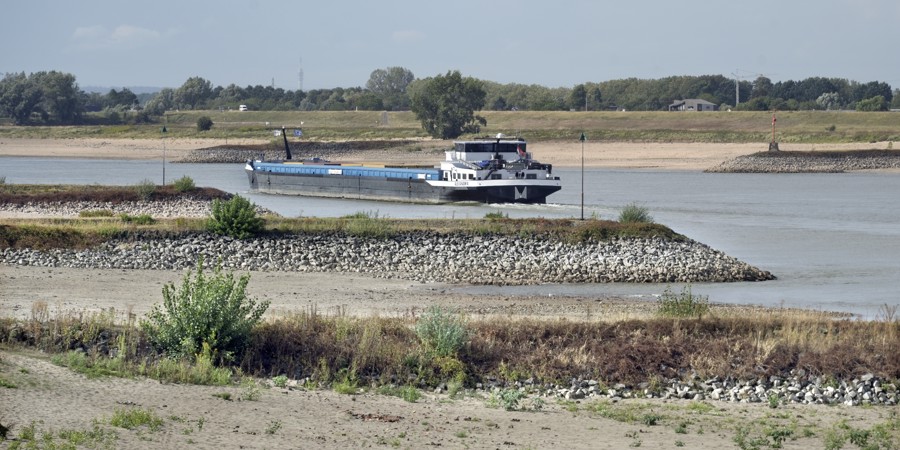
In the summer of 2026, inland waterway transport was severely affected by drought: water levels in rivers dropped, meaning that vessels could carry less weight. In July, too, the total weight carried was lower than a year earlier, at 9.3 percent. However, the number of journeys per inland vessel was up: by 0.9 percent in July and by 3.4 percent in August.
The average weight transported per journey in August was 1,299 tonnes. That is comparable to 2018 and 2022, when water levels were also very low. Between 2012 and 2025, the average weight of goods transported by inland waterways in August was around 1,500 tonnes.
| Jaar | July (billion tonnes) | August (billion tonnes) |
|---|---|---|
| 2012 | 28.2 | 27.7 |
| 2013 | 29.3 | 27.5 |
| 2014 | 30.3 | 27.8 |
| 2015 | 29.4 | 26.7 |
| 2016 | 30.5 | 27.6 |
| 2017 | 30.6 | 29.0 |
| 2018 | 30.0 | 26.2 |
| 2019 | 29.8 | 26.5 |
| 2020 | 27.5 | 25.0 |
| 2021 | 30.1 | 27.8 |
| 2022 | 27.7 | 23.9 |
| 2023 | 26.3 | 25.1 |
| 2024 | 29.3 | 25.9 |
| 2025 | 27.6 | 26.8 |
| 2026 | 25.1 | 21.8 |
Cross-border transport down, domestic goods transport up
The decrease in the weight of goods transported by inland vessels was particularly pronounced in cross-border transport. In August 2026, transport between the Netherlands and other countries saw a significant decline: imports of goods were 20.2 percent lower than a year earlier, while exports fell by 22.2 percent. The Netherlands also saw a significant decline in transit trade – where both loading and unloading take place abroad. This was down by 50.1 percent, year on year. Domestic transport, however, rose by 0.4 percent.
The transport of goods via inland waterways saw a decline to almost all countries. Transport to and from Germany, one of the Netherlands’ most important trading partners, fell by the most: the weight of goods transported to Germany fell by 2 million tonnes (39.7 percent), and 1 million tonnes (49.5 percent) less freight arrived in the Netherlands. The vast majority of this transport takes place via the river Rhine, where water levels at Lobith (on the German-Dutch border) were lower than ever this summer. Transport to and from Belgium, however, increased: imports rose by 8.8 percent, while exports rose by 1.6 percent.
| Stroom | 2026 ( billion tonnes) | 2025 ( billion tonnes) |
|---|---|---|
| Domestic transport | 8.3 | 8.3 |
| Imports | 4.2 | 5.2 |
| Exports | 7.3 | 9.4 |
| Transit trade | 1.9 | 3.8 |
Transport volumes increased in the first half of 2025
In the first six months of 2026, the weight of goods transported by inland waterways was 6.3 percent higher than in the first half of 2025. The transport of all types of goods increased during this period, with the strongest growth seen in liquid bulk goods such as diesel and petrol at 10.4 percent.
| Maand | % change (year-on-year % change) |
|---|---|
| January | 4.1 |
| February | 3.7 |
| March | 9.7 |
| April | 10.5 |
| May | 5.9 |
| June | 3.7 |
| July | -9.3 |
| August | -18.6 |