Largest drop in business confidence since early 2022
- Business confidence has fallen and is now negative across all economic sectors.
- More firms now expect a rise in prices.
- Labour shortage reported less frequently as an issue.
Business confidence fell to -14.8 at the start of the second quarter of 2026. This is the largest fall in confidence since early 2022. More companies also expect a rise in sale prices. This is reported by Statistics Netherlands (CBS), the Netherlands Chamber of Commerce (KVK), the Economic Research Institute in the field of construction, housing and the built environment (EIB), The Royal Association for Small and Medium-Sized Enterprises (MKB-Nederland) and the Confederation of Netherlands Industry and Employers (VNO-NCW) on the basis of the Business Survey Netherlands (COEN).
The reason for this fall in business confidence is the negative sentiment among entrepreneurs about the current state of the economy and the future economic outlook. It is the sharpest decrease in confidence since early 2022, during the last pandemic lockdown. Business confidence is now at its lowest level since late 2022, when energy prices rose sharply following Russia’s invasion of Ukraine. It is the most negative in the province of Fryslân (Friesland) and least negative in the province of Utrecht.
| Jaar | Maand | Business confidence (Average of the sub-questions) |
|---|---|---|
| 2022 | Jan | -0.3 |
| 2022 | Apr | -7.6 |
| 2022 | Jul | -10.9 |
| 2022 | Oct | -20.3 |
| 2023 | Jan | -12 |
| 2023 | Apr | -6.8 |
| 2023 | Jul | -7.4 |
| 2023 | Oct | -8.7 |
| 2024 | Jan | -7.1 |
| 2024 | Apr | -5.8 |
| 2024 | Jul | -3.7 |
| 2024 | Oct | -3.1 |
| 2025 | Jan | -5.2 |
| 2025 | Apr | -7.1 |
| 2025 | Jul | -3.9 |
| 2025 | Oct | -4.1 |
| 2026 | Jan | -1.8 |
| 2026 | Apr | -14.8 |
| Source: CBS, EIB, KVK, VNO-NCW, MKB-Nederland | ||
Business confidence is negative across all sectors
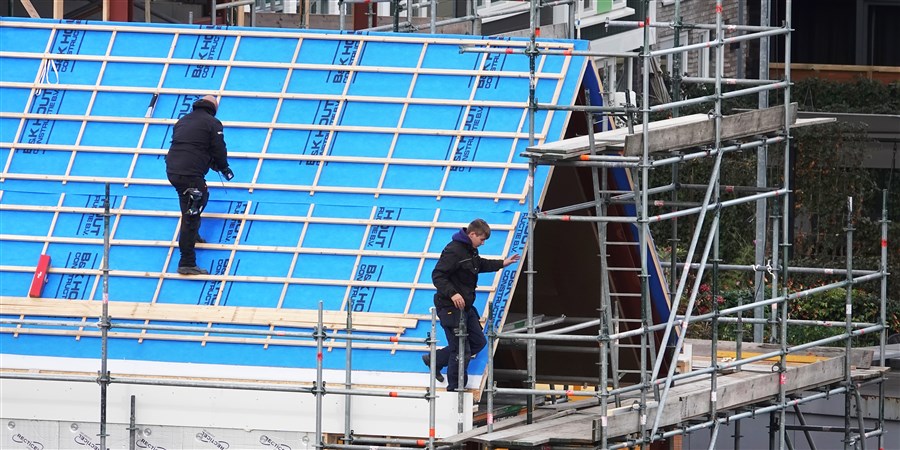
Confidence has fallen across all sectors and is now negative. It has fallen the most sharply in the construction sector. Many other indicators, such as the order book for construction, remain positive however. The business services sector saw the smallest fall in confidence and has the least negative confidence of all sectors. In the information and communication sector and the car trade and repair sector, confidence has shifted from positive to slightly negative. Business confidence is at its lowest in the agriculture, forestry and fishing sector.
Uncertainty about the current economic situation is highest among companies in the manufacturing sector and in transportation and storage. In these sectors, uncertainty has also increased the most, quarter on quarter. Uncertainty is lower in the trade and the services sector, but is lower there too.
| Bedrijfstakken/branches (SBI 2008) | April 2026 (Average across all survey questions) | January 2026 (Average across all survey questions) |
|---|---|---|
| Total (excl. financial and utility companies) | -14.8 | -1.8 |
| Business services | -2.9 | 0.3 |
| Information and communication | -4.9 | 9.2 |
| Car trade and repair | -5.2 | 5.8 |
| Culture, sports and recreation | -7.6 | -1.1 |
| Real estate activities | -10.6 | -3.5 |
| Manufacturing | -10.9 | -2.9 |
| Retail trade (excl. cars) | -11.8 | 1.4 |
| Transportation and storage | -13.5 | -4.7 |
| Wholesale and commission trade | -19.4 | -3.9 |
| Construction | -29.4 | 1.1 |
| Accommodation and food services | -30.1 | -12 |
| Agriculture, forestry and fishing | -36.3 | -20.6 |
| Source: CBS, EIB, KVK, VNO-NCW, MKB-Nederland | ||
More firms expect prices to rise
On balance, 30 percent of companies expect prices to rise over the next three months, compared with 20 percent a quarter earlier. However, this figure is still lower than during the peak in 2022, when 47 percent of firms expected prices to rise. In trade and manufacturing, the balance has more than doubled compared with the previous quarter. In the services sector, too, more entrepreneurs expect price rises, but the net figure, at just over 21 percent, is lower than in trade and manufacturing.
| Jaar | Maand | Total (excl. financial and utility companies) (Net balance: % of positive responses and % of negative responses) | Manufacturing (Net balance: % of positive responses and % of negative responses) | Trade (Net balance: % of positive responses and % of negative responses) | Services (Net balance: % of positive responses and % of negative responses) |
|---|---|---|---|---|---|
| 2022 | jan | 31.4 | 40.8 | 35.2 | 18.1 |
| 2022 | apr | 46.9 | 55.6 | 60.2 | 28.2 |
| 2022 | jul | 40.1 | 44.9 | 51.8 | 26.6 |
| 2022 | okt | 44.4 | 48 | 54.6 | 31.8 |
| 2023 | jan | 38.4 | 34.9 | 45.2 | 32.9 |
| 2023 | apr | 22.6 | 14.4 | 27.1 | 20.9 |
| 2023 | jul | 15.5 | 7.3 | 14.9 | 18.2 |
| 2023 | okt | 15.9 | 8.1 | 14.7 | 17 |
| 2024 | jan | 19.5 | 6.1 | 15.1 | 22 |
| 2024 | apr | 14.6 | 8.8 | 11.6 | 16 |
| 2024 | jul | 16.9 | 13.6 | 12.6 | 17.2 |
| 2024 | okt | 15 | 12 | 11.1 | 15.7 |
| 2025 | jan | 20.6 | 15.2 | 20.4 | 19.2 |
| 2025 | apr | 18.2 | 15.6 | 14.1 | 16.6 |
| 2025 | jul | 17.4 | 12.8 | 15.7 | 16.4 |
| 2025 | okt | 16.8 | 11.3 | 16.8 | 14.7 |
| 2026 | jan | 20.3 | 12 | 16.9 | 18.8 |
| 2026 | apr | 29.7 | 27.2 | 35.2 | 21.6 |
| Source: CBS, EIB, KVK, VNO-NCW, MKB-Nederland | |||||
Labour shortage less likely to be named the main issue facing companies
30 percent of firms still mention labour shortages as the main issue they are facing, but this percentage has fallen steadily since it peaked in July 2022. Then, almost half of all companies reported being affected by labour shortages.
Just over 19 percent of firms now report weak demand as the main issue they are facing. Financial constraints are mentioned as the main issue faced by 11 percent of firms. Despite a slight increase, a shortage of production resources is the main obstacle for only 8 percent of firms.
The share of firms naming ‘other factors’ has risen from just over 12 percent to just over 17 percent, quarter on quarter. Here, companies mention factors such as the current geopolitical situation, economic uncertainty, and legislation and regulations. Almost one-third of firms say they are not experiencing any issues at all.
| Jaar | Maand | Insufficient demand (% of businesses) | Labour shortage (% of businesses) | Shortage of production resources (% of businesses) | Financial constraints (% of businesses) | Other (% of businesses) |
|---|---|---|---|---|---|---|
| 2022 | Jan | 11.9 | 35 | 17.1 | 4.5 | 20.7 |
| 2022 | Apr | 10.6 | 43.7 | 23.9 | 4.5 | 14.1 |
| 2022 | Jul | 11.3 | 49.3 | 22.4 | 5.2 | 11.5 |
| 2022 | Oct | 14.1 | 48.2 | 20.4 | 6.9 | 13.7 |
| 2023 | Jan | 15 | 44.4 | 16.1 | 8.4 | 11 |
| 2023 | Apr | 16.2 | 42.9 | 13.7 | 7.3 | 9.7 |
| 2023 | Jul | 16.8 | 42.3 | 12.3 | 7.1 | 9.6 |
| 2023 | Oct | 19.6 | 41.7 | 9.5 | 8.8 | 10 |
| 2024 | Jan | 20.8 | 37.5 | 7.6 | 8.5 | 9.1 |
| 2024 | Apr | 21.2 | 38.4 | 8 | 8.2 | 8.8 |
| 2024 | Jul | 19.8 | 36.9 | 8.3 | 8.8 | 8.4 |
| 2024 | Oct | 20.4 | 39.9 | 7.5 | 8.7 | 9.3 |
| 2025 | Jan | 19 | 35.8 | 7.1 | 10.3 | 9.4 |
| 2025 | Apr | 18.8 | 33.9 | 8.2 | 9.9 | 10.5 |
| 2025 | Jul | 19.8 | 36.3 | 6.4 | 10.4 | 11.7 |
| 2025 | Oct | 21.8 | 33.3 | 6 | 10.4 | 13.3 |
| 2026 | Jan | 19.7 | 31.5 | 6.4 | 10.3 | 12.6 |
| 2026 | Apr | 19.6 | 30.1 | 7.8 | 10.9 | 17.4 |
| Source: CBS, EIB, KVK, VNO-NCW, MKB-Nederland | ||||||
| 1)Businesses can select a maximum of two options. The options 'none' and 'weather conditions' are not included. | ||||||