Electricity consumption of domestic transport nearly doubles
| Jaar | Services, waste, water and repairs (PJ) | Industry (excl. energy sector) (PJ) | Homes (PJ) | Agriculture, forestry and fishing (PJ) | Energy sector (PJ) | Domestic transport (PJ) | Other (PJ) |
|---|---|---|---|---|---|---|---|
| 2019 | 133.9 | 128.8 | 77.7 | 42.4 | 29.3 | 8.5 | 0.4 |
| 2020 | 131.2 | 129.3 | 79.1 | 39.2 | 26.0 | 8.3 | 0.4 |
| 2021 | 134.5 | 128.0 | 80.9 | 37.8 | 29.5 | 9.7 | 0.4 |
| 2022 | 137.5 | 122.6 | 80.1 | 25.8 | 29.2 | 12.0 | 0.3 |
| 2023 | 136.8 | 115.9 | 76.8 | 27.1 | 26.3 | 14.0 | 0.4 |
| 2024 | 141.6 | 114.8 | 75.5 | 32.2 | 25.6 | 16.7 | 0.3 |
In 2024, the Netherlands consumed a total of 407 PJ of electricity, 2 percent more than in 2023. However, consumption remains 3 percent lower than in 2019, before the coronavirus pandemic.
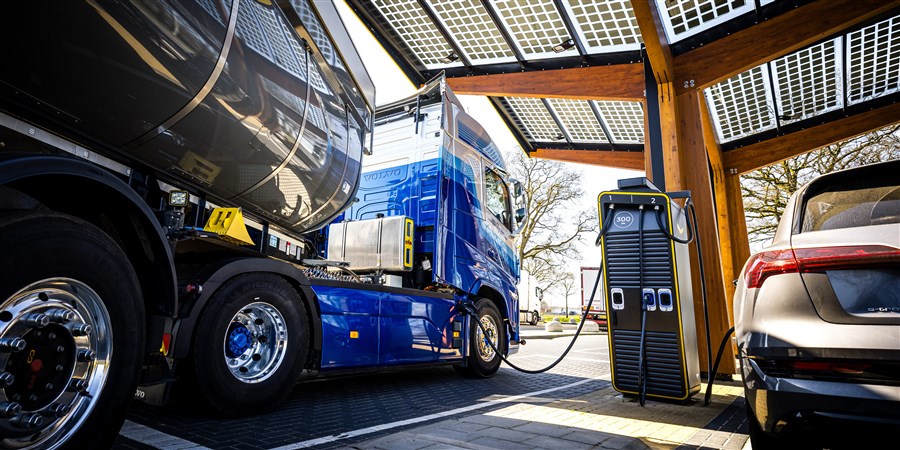
Electricity consumption in the domestic transport sector increased from 9 PJ to 17 PJ between 2019 and 2024. Electricity consumed by road vehicles rose, in particular, with a five-fold increase. This was mainly because of the increasing number of plug-in cars. Since 2023, road vehicles have consumed more electricity than rail traffic. Domestic transport accounted for 4 percent of total electricity consumption in 2024.
Most electricity (35 percent of the total) is consumed in the services, waste, water and repairs sector. In 2024, consumption in this sector rose by 4 percent compared to 2023.
Electricity supplied to the information and communication sector has risen by half
The creation of new data centres means that the electricity consumption of the information and communications sector was over 50 percent higher in 2024 than it was in 2019. The total consumed in 2024 was 22 PJ.Within the manufacturing sector, electricity consumption actually fell by 11 percent over the same period. In the base metal sector, excluding blast furnaces, electricity consumption in 2024 was around 42 percent lower than it was in 2019. This was due to the closure of one large firm.
The agriculture, forestry and fishing sector consumed almost a quarter less electricity in 2024 than it did in 2019, at 32 PJ. This was due to more efficient lighting in greenhouses in the horiticulture sector, combined with a fall in the total area of greenhouses.
Homes consume nearly one-fifth of all electricity in the Netherlands
Homes accounted for nearly one-fifth of total electricity consumption (75.5 PJ) in 2024. Domestic consumption has fluctuated over the past decade due to increasingly fuel-efficient electrical appliances and lighting on the one hand, but an increase in electricity consumed by heat pumps and electrical appliances on the other.
Electricity consumed in order to charge plug-in vehicles at home does not count as residential consumption for the purposes of these figures, but as domestic transport.
| Jaar | Energy sector (PJ) | Services, waste, water and repairs (PJ) | Homes (PJ) | Industry (excl. energy sector) (PJ) | Agriculture, forestry and fishing (PJ) | Domestic transport (PJ) | Other (PJ) |
|---|---|---|---|---|---|---|---|
| 2019 | 339.2 | 24.7 | 9.2 | 20.2 | 43.8 | 0.0 | 0.0 |
| 2020 | 326.5 | 28.2 | 12.9 | 31.5 | 44.6 | 0.0 | 0.0 |
| 2021 | 312.7 | 31.7 | 16.7 | 31.0 | 47.8 | 0.0 | 0.0 |
| 2022 | 308.7 | 36.5 | 24.3 | 30.3 | 37.7 | 0.0 | 0.0 |
| 2023 | 298.6 | 38.2 | 30.4 | 28.1 | 41.6 | 0.0 | 0.0 |
| 2024 | 300.3 | 38.2 | 33.5 | 28.6 | 42.9 | 0.0 | 0.0 |
More electricity generated outside the energy sector
The Netherlands produced 443 PJ of electricity in 2024. That was 1 percent more than in 2019. Of this total, 68 percent was produced by the energy sector itself. Almost 32 percent of all the electricity generated came from outside the energy sector. In 2019, that share was 22 percent.The production of electricity by homes has tripled as more solar panels have been installed on roofs. In 2024, homes accounted for 8 percent of electricity generated. Due to the installation of solar panels on the roofs of business premises and in industrial areas in the services sector, electricity production by businesses has almost tripled since 2019.
In agriculture, a great deal of electricity is generated for use in greenhouses using gas-powered motors and solar panels. Agriculture accounted for 10 percent of total electricity production, the same share as in 2019.
Sources
- StatLine - Electricity and heat; production and input by energy commodity
- StatLine - Energy balance sheet; supply and consumption, sector
- StatLine - Energy balance sheet; supply, transformation and consumption
- StatLine - Electricity balance sheet; supply and consumption
- StatLine - Renewable energy; consumption by energy source, technology and application
- StatLine - Vegetables; yield and cultivated area per kind of vegetable
- StatLine - Agriculture; crops, livestock and land use by general farm type, region
Related items
- News release - More than 1 million plug-in cars in the Netherlands
- News release - Half of electricity is produced from renewable sources
- News release - Consumption of energy from renewable sources rises to 20 percent