Fewer strikes in 2025, but more working days lost
- There were 13 fewer strikes in 2025 than there were in 2024.
- The manufacturing sector saw the highest number of strikes.
- Employees are more satisfied with their pay and terms of employment than in recent years.
There were 23 strikes in 2025, which was 13 fewer than in 2024. The strikes held in 2025 lasted longer on average, however, resulting in more working days lost to industrial action. Almost 60 thousand working days were lost to strikes in 2025, up by 6 thousand on 2024. Statistics Netherlands (CBS) reports this on the basis of newly released figures.
After reaching a peak of 52 strikes in 2023, the number of strikes has now fallen for the second consecutive year. This means that the number of strikes is now back to the average figure since 2000. Between 1999 and 2025, there were 24 strikes per year, on average.
| Jaartal | Strikes |
|---|---|
| 1999 | 24 |
| 2000 | 23 |
| 2001 | 16 |
| 2002 | 16 |
| 2003 | 14 |
| 2004 | 12 |
| 2005 | 28 |
| 2006 | 31 |
| 2007 | 20 |
| 2008 | 21 |
| 2009 | 25 |
| 2010 | 21 |
| 2011 | 17 |
| 2012 | 18 |
| 2013 | 24 |
| 2014 | 25 |
| 2015 | 27 |
| 2016 | 25 |
| 2017 | 32 |
| 2018 | 28 |
| 2019 | 26 |
| 2020 | 9 |
| 2021 | 22 |
| 2022 | 33 |
| 2023 | 52 |
| 2024 | 36 |
| 2025 | 23 |
Fewer workers took part in strikes
Over 10 thousand workers took part in strikes in 2025, which was half the number involved in 2024. Despite fewer strikes and fewer workers taking part, the number of working days lost to strikes actually increased. This was because the strikes that did take place in 2025 were relatively long. None of them lasted less than one working day, unlike in 2024.
| Jaartal | Workers participating (x 1,000) | Working days lost (x 1,000) |
|---|---|---|
| 1999 | 58.9 | 75.8 |
| 2000 | 10.3 | 9.4 |
| 2001 | 37.4 | 45.1 |
| 2002 | 28.6 | 245.5 |
| 2003 | 10.8 | 15.0 |
| 2004 | 104.2 | 62.2 |
| 2005 | 29.0 | 41.7 |
| 2006 | 11.3 | 15.8 |
| 2007 | 20.7 | 26.4 |
| 2008 | 51.9 | 120.6 |
| 2009 | 3.6 | 4.6 |
| 2010 | 14.1 | 59.2 |
| 2011 | 47.1 | 22.0 |
| 2012 | 89.6 | 219.4 |
| 2013 | 4.5 | 19.4 |
| 2014 | 10.2 | 40.9 |
| 2015 | 42.4 | 47.6 |
| 2016 | 11.1 | 19.2 |
| 2017 | 146.9 | 306.3 |
| 2018 | 33.7 | 239.1 |
| 2019 | 318.7 | 391.0 |
| 2020 | 105.3 | 211.0 |
| 2021 | 28.2 | 59.3 |
| 2022 | 16.5 | 39.4 |
| 2023 | 17.4 | 142.1 |
| 2024 | 21.3 | 53.7 |
| 2025 | 10.3 | 59.9 |
Most strikes in the manufacturing sector
The manufacturing sector saw the most frequent strikes, with ten in 2025. However, strikes in the trade sector involved the most workers: more than 4 thousand, while in manufacturing it was less than a thousand. In the trade sector, this led to a relatively high number of lost working hours; 17 thousand working days in total. There were five strikes in the transportation and storage sector. These involved 2 thousand employees and led to over 6 thousand lost working days.
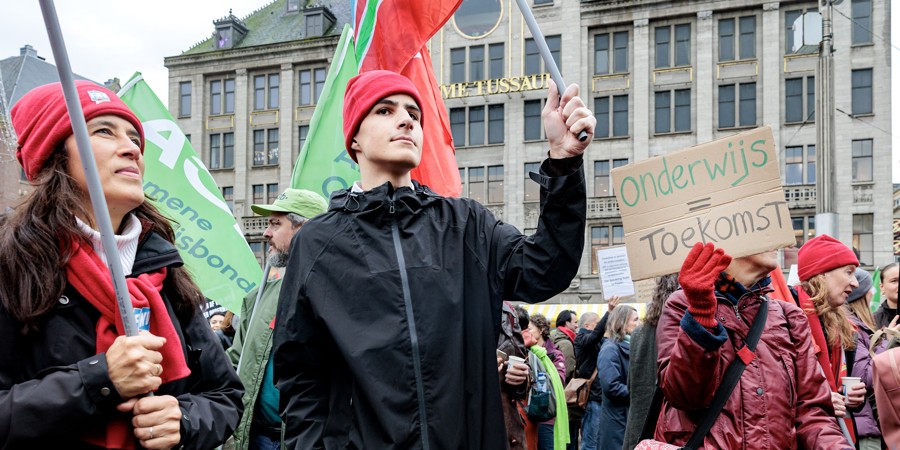
The largest strike of the year took place in the education sector. With over 28 thousand working days lost, this strike accounted for almost half of the total for 2025. Since this was a staggered strike, however, it involved only 2 thousand workers, a relatively low number.
| Bedrijfstak | Strikes |
|---|---|
| Manufacturing | 10 |
| Tranportation and storage | 5 |
| Trade | 4 |
| Other | 4 |
Most strikes concerned collective labour agreements
As in the past three years, most strikes concerned the collective labour agreement of the workers involved. A collective labour agreement is a sector-specific deal between employers and employees that includes workers’ pay and working conditions. In 2025, 10 out of 23 strikes related to the relevant collective labour agreement. In addition, four strikes concerned wage issues and four related to other matters. The strike in the education sector was a response to spending cuts announced by the government.
Other forms of industrial action were also the most common in manufacturing
In 2025, there were 63 instances of other forms of industrial action (other than strikes). These were organised protests that did not result in the loss of any working hours, such as reduced production, demonstrations or wearing badges. As with strikes, such actions were most common in the manufacturing sector, with 17 instances.
Of these, 27 were due to dissatisfaction with collective labour agreements, which made this the most frequently cited reason for industrial action. This was less frequent than in 2023, in relative terms. In that year, 42 out of 51 instances of non-strike industrial action were related to the collective labour agreement.
Higher levels of satisfaction regarding collective labour agreements and pay
In 2025, employees were more satisfied with their collective labour agreement and pay than in previous years. This is according to the National Working Conditions Survey conducted by Statistics Netherlands (CBS) and TNO. In 2025, 83 percent of employees said they were (very) satisfied with their collective labour agreement and 80 percent said they were (very) satisfied with their pay. In 2022, these figures were 77 and 74 percent respectively.
| Jaartal | Satisified with collective labour agreement (%) | Satisfied with pay (%) |
|---|---|---|
| 2022 | 77.1 | 74.0 |
| 2023 | 80.8 | 77.7 |
| 2024 | 82.1 | 79.1 |
| 2025 | 83.0 | 79.9 |
| Source: CBS, TNO | ||
Employees in education sector were the most satisfied with their collective labour agreement
Employees in the education sector were the most satisfied with their collective labour agreement (92 percent), while employees in the information and communication sector were the least satisfied (70 percent). Satisfaction with pay was the highest in the financial services sector (91 percent) and lowest in the trade, transport and hospitality sectors (74 percent). In public administration, a relatively large proportion of employees were satisfied with both their collective labour agreement and their pay (both 90 percent).
| Bedrijfstak | Collective labour agreement (%) | Pay (%) |
|---|---|---|
| Education | 92.2 | 86.7 |
| Public administration | 90.5 | 90.4 |
| Construction | 88.8 | 85.2 |
| Agriculture, forestry and fishing | 87.0 | 83.0 |
| Real estate | 87.0 | 90.1 |
| Health care and human well-being | 84.6 | 76.8 |
| Energy | 84.6 | 83.5 |
| Financial services | 83.5 | 91.3 |
| Trade, transportation and hospitality | 78.5 | 73.9 |
| Culture, recreation, other services | 78.1 | 76.6 |
| Business services | 76.1 | 77.8 |
| Information and communication | 70.1 | 81.2 |
| Source: CBS, TNO | ||