Biological pest control used in 94 percent of greenhouse cultivation
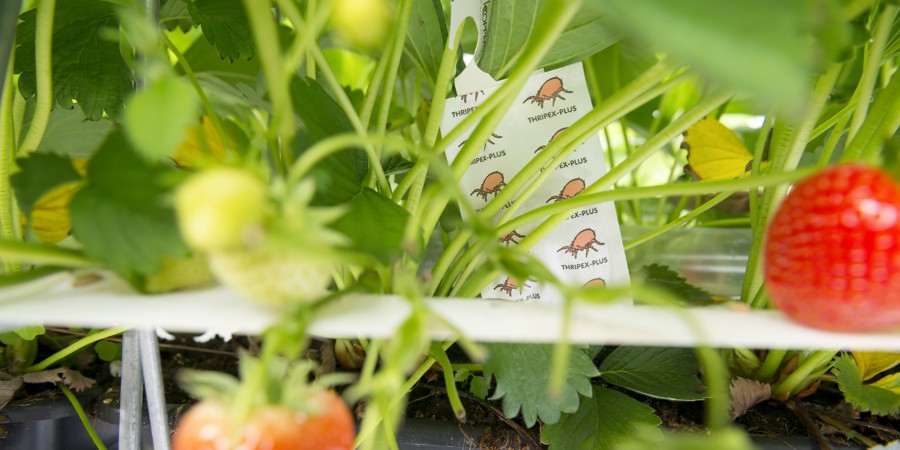
Growers of cucumbers, peppers, tomatoes, strawberries, gerberas, chrysanthemums, roses, potted flowering plants and foliage plants were asked about their use of biological forms of pest control. Around half of greenhouse growers cultivate one of these crops, and together they account for 70 percent of the total area under greenhouse cultivation, which is 10 thousand hectares in the Netherlands.
In addition to predatory mites and predatory thrips, other biological pest control agents such as ichneumon wasps, gall midges and predatory bugs, flies and beetles were also deployed over a larger share of the total cultivated area than in 2020. Nematodes were the biological pest control agent deployed the least in greenhouses, at 12 percent of the cultivated area.
| Groep biologische bestrijders | 2024* (% of cultivated area) | 2020 (% of cultivated area) | 2016 (% of cultivated area) | 2012 (% of cultivated area) |
|---|---|---|---|---|
| Total | 94.4 | 94.4 | 92.0 | 77.6 |
| Predatory mites and thrips | 83.6 | 69.3 | 65.8 | 51.3 |
| Ichneumon wasps and gall midges | 76.6 | 74.2 | 67.1 | 52.3 |
| Predatory bugs and beetles, lacewings and flies | 65.4 | 60.8 | 53.6 | 50.5 |
| Nematodes | 11.8 | 8.7 | 13.6 | 7.9 |
| ¹⁾ Several biological pest control agents may be deployed at the same time * Provisional figures | ||||
Biological pest control agents used in majority of greenhouse cultivation
For most greenhouse crops, biological pest control agents are used on over 95 percent of the total cultivated area to control harmful insects or spider mites. In cucumber and tomato cultivation, for instance, biological pest control agents were already in use across almost the entire cultivated area in 2020. For potted flowering plants and foliage plants the percentage was lower, but still well above 75 percent.
| Gewas | 2024* (% of cultivated area) | 2020 (% of cultivated area) |
|---|---|---|
| Cucumber | 100.0 | 100.0 |
| Tomato | 100.0 | 100.0 |
| Gerbera | 100.0 | 97.5 |
| Bell pepper | 99.7 | 100.0 |
| Rose | 98.5 | 100.0 |
| Strawberry | 96.8 | 97.8 |
| Chrysanthemum | 96.2 | 93.2 |
| Foliage plants | 83.9 | 80.8 |
| Potted plants (flowering) | 77.8 | 74.5 |
| * provisional figures | ||
Largest increase in the use of predatory mites in tomato cultivation
The total cultivated area over which predatory mites and predatory thrips were deployed increased by the most in tomato cultivation: from 18 percent in 2020 to 66 percent in 2024. The use of ichneumon wasps and gall midges has increased particularly in the cultivation of potted flowering plants, from 29 percent in 2020 to 45 percent in 2024. Their use in chrysanthemum cultivation also saw a sharp increase, from 68 percent to 82 percent. The use of predatory bugs, predatory beetles, lacewings and hoverflies increased the most in chrysanthemum cultivation: from 10 percent to 44 percent.
Microbiological agents used on over two-thirds of cultivated area
In addition to biological control agents, microbiological agents (such as bacteria fungi and viruses) are another more sustainable alternative to chemical agents when it comes to the control of insects. These agents are used to combat insects on 67 percent of the area used for greenhouse cultivation. They are used the most in gerbera cultivation, at 90 percent of the cultivated area. Microbiological agents are used the least in cucumber cultivation (50 percent).
| Gewas | 2024* (% of cultivated area) |
|---|---|
| Gerbera | 89.6 |
| Tomato | 81.9 |
| Rose | 76.7 |
| Bell pepper | 76.3 |
| Strawberry | 65.3 |
| Foliage plants | 54.3 |
| Chrysanthemum | 53.8 |
| Potted plants (flowering) | 51.7 |
| Cucumber | 50.0 |
| ¹⁾ for insect control * provisional figures | |
Outside the greenhouse cultivation sector, the use of microbiological agents for insect control is less common, according to research on the use of microbiological agents in the cultivation of 44 agricultural crops. They are used the least in arable farming. In the cultivation of apples, pears and trees for parks and urban areas (e.g. chestnut, birch and Japanese cherry) and fruit tree propagation, the use of these agents is between 10 and 25 percent of the total cultivated area.