More excess nitrogen due to poor harvest, but less nitrogen in manure
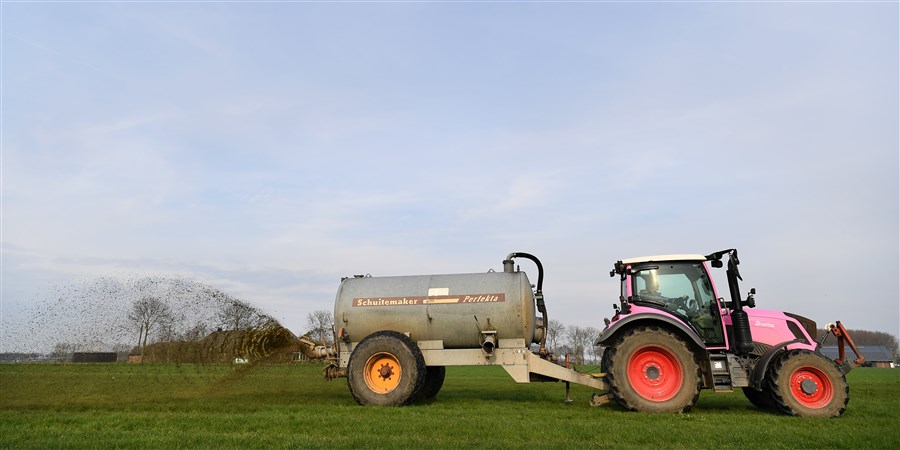
Excess nitrogen from agriculture represents the nitrogen compounds that are not fixed in animal and plant products, but end up in the soil or in the atmosphere. It is calculated by subtracting the amount of nitrogen fixed in animal products (meat, milk, eggs) and plant products (arable and horticultural crops) from the total amount of nitrogen supplied, including in the form of feed concentrate for livestock and fertiliser.
| Jaar | Total (1990=100) | Soil (1990=100) | Air (1990=100) |
|---|---|---|---|
| 1990 | 100.0 | 100.0 | 100.0 |
| 1991 | 103.7 | 103.4 | 104.1 |
| 1992 | 95.8 | 103.5 | 84.0 |
| 1993 | 95.0 | 102.2 | 83.9 |
| 1994 | 96.1 | 113.0 | 70.4 |
| 1995 | 100.3 | 126.7 | 60.2 |
| 1996 | 93.9 | 114.8 | 61.9 |
| 1997 | 90.0 | 110.9 | 58.1 |
| 1998 | 95.4 | 123.8 | 52.2 |
| 1999 | 87.4 | 110.7 | 52.0 |
| 2000 | 76.2 | 96.2 | 45.7 |
| 2001 | 67.6 | 83.5 | 43.5 |
| 2002 | 57.9 | 68.7 | 41.3 |
| 2003 | 68.1 | 85.9 | 41.1 |
| 2004 | 61.7 | 75.8 | 40.2 |
| 2005 | 59.4 | 72.1 | 40.1 |
| 2006 | 60.4 | 72.4 | 42.1 |
| 2007 | 55.6 | 65.0 | 41.4 |
| 2008 | 49.6 | 57.1 | 38.1 |
| 2009 | 48.6 | 55.9 | 37.5 |
| 2010 | 47.7 | 54.1 | 37.9 |
| 2011 | 46.2 | 52.3 | 36.8 |
| 2012 | 46.8 | 54.7 | 34.7 |
| 2013 | 47.3 | 55.7 | 34.6 |
| 2014 | 44.6 | 50.3 | 35.8 |
| 2015 | 54.3 | 66.0 | 36.6 |
| 2016 | 53.5 | 64.2 | 37.1 |
| 2017 | 48.6 | 55.7 | 37.9 |
| 2018 | 54.0 | 64.9 | 37.4 |
| 2019 | 47.1 | 54.6 | 35.6 |
| 2020 | 49.1 | 58.2 | 35.3 |
| 2021 | 46.5 | 54.5 | 34.2 |
| 2022 | 48.3 | 57.8 | 33.9 |
| 2023 | 42.0 | 48.3 | 32.4 |
| 2024 | 47.4 | 58.6 | 30.3 |
Less nitrogen in the atmosphere, more in soil
Around 7 percent less nitrogen (75 million kilograms) ended up in the atmosphere in 2024, compared to 2023. This is partly because the livestock population is declining but also due to innovations in agriculture, such as new shed systems. The amount of nitrogen that entered the soil from agriculture was up by 21 percent to 220 million kilograms. That was partly due to lower crop yields, which meant that less nitrogen was taken up by crops. Harvests in 2023 were better, so less nitrogen was lost into the soil.Smaller harvest of wheat and silage maize, less nitrogen taken up by crops
The wheat harvest of 2024 was the smallest in 25 years. Winter wheat yields in particular were relatively low due to the wet conditions in the autumn of 2023. The harvest of silage maize was the smallest in nearly 30 years, due to the wet spring. As a result, only 253 million kilograms of nitrogen was removed from the soil through the harvesting of roughage for livestock. That was a fall of 10 percent, year on year.
The livestock sector consumed 260 million kilograms of nitrogen in the form of roughage (feed concentrate). That was 7 million kilograms more nitrogen from roughage than was harvested; the remainder came from the 2023 stockpile in the form of bales and pits.
Less nitrogen in feed concentrate, more in fertilisers
The two main sources of nitrogen in agriculture area feed concentrates (384 million kg) and fertilisers (201 million kg). Nitrogen input from feed concentrate was down by 3 percent relative to 2023. This is because the volume of nitrogen supplied in feed concentrate is falling as the livestock population declines. At the same time, 201 million kilograms of nitrogen was applied in the form of fertiliser, a 2 percent increase.Less livestock manure
The Netherlands is required to comply with the Nitrates Directive standard of 170 kilograms of nitrogen per hectare of farmland in the form of livestock manure. The Netherlands is permitted to exceed this ceiling under certain conditions (this exception is known as derogation). However, that derogation is being phased out with effect from 2023, and from 2026 the Netherlands will no longer be granted any derogation at all.
The total amount of nitrogen excreted in animal manure in 2024 was 449 million kilograms, 3 percent less than in 2023. Of this, 332 million kilograms of nitrogen was applied to farmland.
| Jaar | Livestock manure (million kg ) | Fertiliser (million kg ) |
|---|---|---|
| 1990 | 580.0 | 395.0 |
| 1991 | 605.3 | 382.7 |
| 1992 | 596.9 | 374.4 |
| 1993 | 585.0 | 372.5 |
| 1994 | 551.7 | 354.2 |
| 1995 | 548.5 | 388.4 |
| 1996 | 550.5 | 371.5 |
| 1997 | 530.5 | 383.2 |
| 1998 | 488.9 | 385.5 |
| 1999 | 471.8 | 365.9 |
| 2000 | 444.1 | 322.1 |
| 2001 | 426.2 | 280.9 |
| 2002 | 390.2 | 274.8 |
| 2003 | 386.4 | 273.2 |
| 2004 | 369.8 | 283.1 |
| 2005 | 366.9 | 261.8 |
| 2006 | 364.0 | 270.4 |
| 2007 | 360.9 | 240.1 |
| 2008 | 356.9 | 220.7 |
| 2009 | 345.4 | 211.4 |
| 2010 | 351.0 | 205.2 |
| 2011 | 342.0 | 200.4 |
| 2012 | 329.2 | 199.5 |
| 2013 | 339.3 | 216.0 |
| 2014 | 352.4 | 213.2 |
| 2015 | 356.1 | 244.9 |
| 2016 | 359.0 | 229.8 |
| 2017 | 367.5 | 230.2 |
| 2018 | 367.1 | 212.3 |
| 2019 | 353.6 | 214.8 |
| 2020 | 355.1 | 217.4 |
| 2021 | 344.9 | 211.8 |
| 2022 | 344.9 | 188.3 |
| 2023 | 342.0 | 196.6 |
| 2024 | 331.9 | 200.9 |
Sources
- StatLine - Livestock manure; production, transport and use, key figures
- StatLine - Arable crops; production, region
Related items
- Dossier - Nitrogen pollution
- News release - Phosphate and nitrogen emitted in livestock manure is above new limits
- News release - Lowest wheat harvest in 25 years
- News release - Agricultural nitrogen surplus at lowest level since 1990