The container in the logistics chain
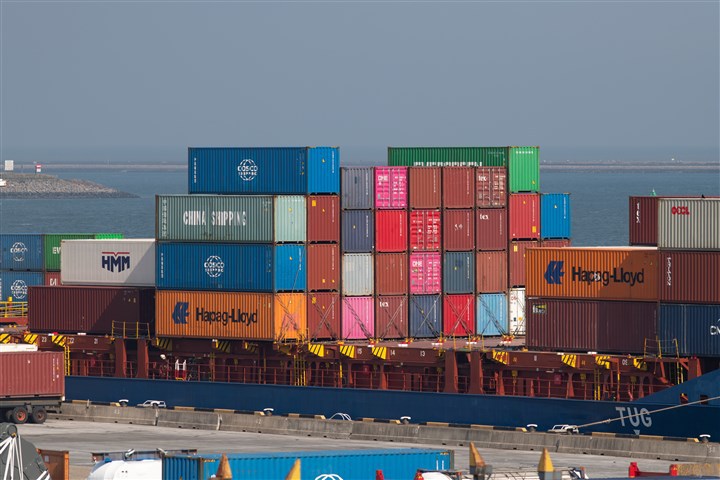
Where do the sea containers arriving in the port of Rotterdam come from? What products do they contain? By what means of transport are they then transported to their next destination (sea vessel, inland vessel, train or lorry)? What is the ultimate destination? In this project, we describe how we try to answer these questions.
Why is this information important? Statistics Netherlands compiles various statistics on goods transport, in particular the transport of containers. These statistics describe only one mode of transport (sea, inland waterway, rail or road). However, combining modes of transport in a single statistic can provide valuable additional insights on:
- Opportunities and obstacles for multimodal transport. A container can easily be transferred from one mode of transport to another if the right infrastructure is available.
- Sustainability. If more containers are transported by rail or inland waterways instead of by road, this can lead to less congestion and emissions.
- Dependencies on certain goods flows, such as those from geopolitically sensitive regions. As the origin and destination are known, the context of movements becomes clearer.
- Infrastructural planning. An important potential user of container chain data is Rijkswaterstaat (RWS). To plan the maintenance and construction of infrastructure, RWS forecasts future transport flows. These depend, among other things, on the type of goods and the origin and destination of these goods. The chain data enables better growth forecasts to be made at a lower regional level.
The logistics container chain is described (statistically) using new data sources (from terminals and transport companies) and innovative methodologies.
What did we do?
The aim of this project is, on the one hand, to improve the methods for constructing container chains and, on the other hand, to share our experiences and insights with other European Member States. This can help them to set up their own container statistics. In the long term, this can also contribute to improving statistics on container chains on Dutch territory by exchanging data with other countries. This project is one of the first projects that attempts to use voluntarily provided private data for official statistics.
For this project, we use a combination of registers and other CBS data on the one hand and private data on the other. In order to make the process of supplying data as easy as possible for companies, no fixed format is prescribed. Companies were asked to provide data on all container movements for a specific period, on a voluntary basis.
Collecting data on a voluntary basis and without a fixed format presents various challenges. It often takes a lot of persuasion to get people to share data. Then the data transfer has to be set up technically. Automating the processing of a large amount of different data formats takes more time than one fixed format. Regular maintenance is also required in the process of data streams (e.g. changes in contact persons, data connection or content).
The collected data must be imported, standardised, and cleaned in order to generate statistical output. Various methods have been developed for this purpose. The various challenges involved in this process are addressed, with particular attention paid to the coding of type of goods and location specifications.
Despite the fact that a lot of additional data has been collected by using private data sources, challenges remain in constructing container chains. The collected data will probably never be complete, which means that some of it will always have to be estimated. However, more data is not always better. There is redundancy in the data because often several parties are involved in a shipment. This redundancy might help to supplement missing data in one source, but may also reveal inconsistencies between sources. A choice then has to be made as to which data is correct.
The various datasets have been combined in order to derive container chains. Missing data has been corrected using an imputation model. The resulting microdata with container chains can be aggregated to desired transport indicators. The challenges and possible solutions for statistical disclosure control have been investigated and possibilities for improving the dataset by sharing data with other countries have been considered.
Results
This project examined and described the various steps involved in processing container data with the aim of compiling statistics on container chains.
Data from private parties can be a useful addition to existing sources from national statistical offices. It takes more time and effort to collect and process the data in an open format, but offering this open format increases willingness to share data. The improvement in quality and additional opportunities to compile statistics that arise from the extra data make the extra effort more than worthwhile.
The additionally collected data provides important insights, such as storage time at terminals and details about the transitions between different modes of transport. The statistics constructed can help policymakers to better plan the construction and maintenance of infrastructure. Good infrastructure helps the transport sector to operate more efficiently. It also allows for better monitoring of the modal shift from road to rail and inland waterways as a result of measures taken.
The research results show that it is possible to develop multimodal container statistics, but improvements in both data collection and estimation methods are still needed to correct for missing data. In collaboration with policymakers and transport companies, we will attempt to validate and, where necessary, improve the calculated figures, such as the modal split from the port of Rotterdam to the hinterland.
Information
For more information about this research, please send an email to MultimodalTransport@cbs.nl.
Co-funded by the European Union under call SMP-ESS-2022-TRANSPORT-STATS-IBA —New transport statistics

Disclaimer: Co-funded by the European Union. Views and opinions expressed are however those of the author(s) only and do not necessarily reflect those of the European Union or Eurostat. Neither the European Union nor the granting authority can be held responsible for them.