A quarter of businesses deploy ICT to use materials sustainably
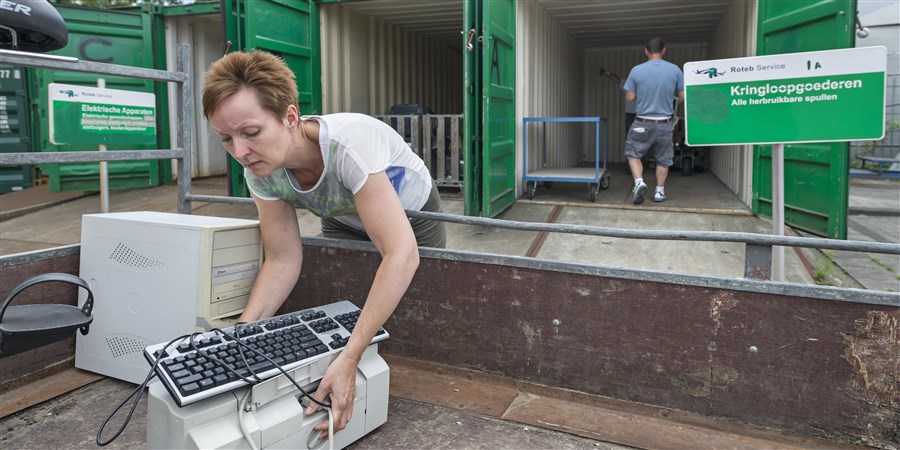
- When it comes to ICT solutions that help businesses use materials more sustainably, the Netherlands ranks in the top five EU member states.
- 90 percent of Dutch businesses dispose of old ICT equipment sustainably, which puts the Netherlands in second place within the EU.
- Businesses in the energy, water and waste management sectors are the most likely to do this.
In 2025, 23 percent of businesses in the Netherlands indicated that they deploy ICT solutions to make their use of materials more sustainable. These businesses may use software to reduce waste, for example, or to sort waste automatically. This puts the Netherlands in fourth place within the EU. In addition, 90 percent of businesses dispose of old ICT equipment in an environmentally friendly manner, which puts the Netherlands in second place within the EU. This is according to recent figures on the use of ICT by businesses from Statistics Netherlands (CBS) and Eurostat.
| Maatregel duurzaamheid | Netherlands (% of businesses) | EU-average (% of businesses) |
|---|---|---|
| Use ICT solutions to: | ||
| use materials more sustainably | 23 | 17 |
| reduce their energy consumption | 21 | 25 |
| Old ICT equipment is: | ||
| disposed of sustainably | 90 | 77 |
| kept within the company | 53 | 49 |
| Source: CBS, Eurostat | ||
| * provisional figures | ||
Businesses deploy ICT solutions - such as 3D printing - to use materials more efficiently, thereby reducing waste. Reducing stock levels and sorting waste automatically to improve recycling are other examples of sustainable ICT solutions.
Around 25 percent of businesses in the EU use ICT solutions to reduce their energy consumption, for example, with energy-efficient lighting systems or smart thermostats. In the Netherlands, 21 percent of businesses do this.
The Netherlands ranks fourth in the EU for sustainable use of materials
Malta (29 percent), Lithuania and Belgium (both 26 percent) have the highest share of businesses that use ICT technologies to reduce their consumption of materials. The average for the EU as a whole is 17 percent. Hungary, Austria and Bulgaria have the lowest shares, at 8 percent.
| Land | Percentage (% of businesses) |
|---|---|
| Malta | 29 |
| Lithuania | 26 |
| Belgium | 26 |
| Netherlands | 23 |
| Denmark | 23 |
| Spain | 23 |
| Cyprus | 22 |
| Sweden | 21 |
| Portugal | 21 |
| Italy | 20 |
| Slovenia | 20 |
| France | 19 |
| Estonia | 19 |
| Romania | 19 |
| Ireland | 18 |
| EU-average | 17 |
| Germany | 16 |
| Finland | 15 |
| Poland | 15 |
| Luxembourg | 14 |
| Greece | 14 |
| Latvia | 13 |
| Slovakia | 10 |
| Czechia | 9 |
| Hungary | 8 |
| Austria | 8 |
| Bulgaria | 8 |
| Croatia¹⁾ | |
| Source: CBS, Eurostat | |
| ¹⁾ no figures available | |
One-third of businesses in energy, water and waste management sectors use ICT solutions
Businesses in the energy, water and waste management sectors are the most likely to use ICT solutions in order to reduce their consumption of materials, at 34 percent. Businesses in the information and communication sector (29 percent) and in trade (24 percent) are also likely to do this. The accommodation and food services sector has the lowest share, at 14 percent.
Dutch businesses in the manufacturing sector are less likely to use ICT solutions in order to reduce their consumption of materials than those in other EU countries.
| Netherlands (% of businesses) | EU-average (% of businesses) | |
|---|---|---|
| Energy, water and waste management | 34 | 23 |
| Information and communication | 29 | 19 |
| Trade | 27 | 17 |
| Manufacturing | 24 | 25 |
| Specialised business services | 22 | 17 |
| Transport and storage | 22 | 14 |
| Real estate activities | 21 | 16 |
| Construction | 21 | 14 |
| Rental, leasing and other services | 19 | 13 |
| Accommodation and food services | 14 | 14 |
| Source: CBS, Eurostat | ||
| * provisional figures | ||
Large enterprises, in particular, (250 employees or more) use ICT solutions in order to reduce their consumption of materials (47 percent). Smaller enterprises (10-50 employees) are less likely to do this (20 percent).
9 in 10 businesses dispose of ICT equipment sustainably
In 2025, 90 percent of businesses indicated that they dispose of ICT equipment that is no longer in use in a sustainable way. They do this by bringing it to collection points for electronic waste, such as municipal recycling centres, or by returning it to the supplier for disposal. In 2022, the share was 73 percent. On this measure, the Netherlands is in second place within the EU, just behind Finland (91 percent). Across the European Union as a whole, 77 percent of businesses were disposing of ICT equipment sustainably in 2025. Businesses in the accommodation and food services sector (92 percent) were the most likely to opt for sustainable disposal.
| Land | Percentage (% of businesses) |
|---|---|
| Finland | 91 |
| Netherlands | 90 |
| Italy | 85 |
| Sweden | 83 |
| Germany | 82 |
| Austria | 80 |
| Spain | 79 |
| Portugal | 77 |
| Belgium | 77 |
| EU-average | 77 |
| Slovakia | 77 |
| Slovenia | 76 |
| Latvia | 76 |
| Lithuania | 74 |
| Malta | 74 |
| Luxembourg | 72 |
| Croatia | 71 |
| France | 69 |
| Cyprus | 69 |
| Greece | 67 |
| Poland | 67 |
| Hungary | 66 |
| Bulgaria | 45 |
| Czechia¹⁾ | |
| Denmark¹⁾ | |
| Ireland¹⁾ | |
| Estonia¹⁾ | |
| Romenia¹⁾ | |
| Source: CBS, Eurostat | |
| ¹⁾ no figures available | |
Around 53 percent of businesses kept their ICT equipment when it was no longer in use, for spare parts for instance. In 2022, the share was 41 percent. This share is higher than the EU average (49 percent).
Sources
- Eurostat - ICT and the environment