End of a downward trend: more waste collected in 2024
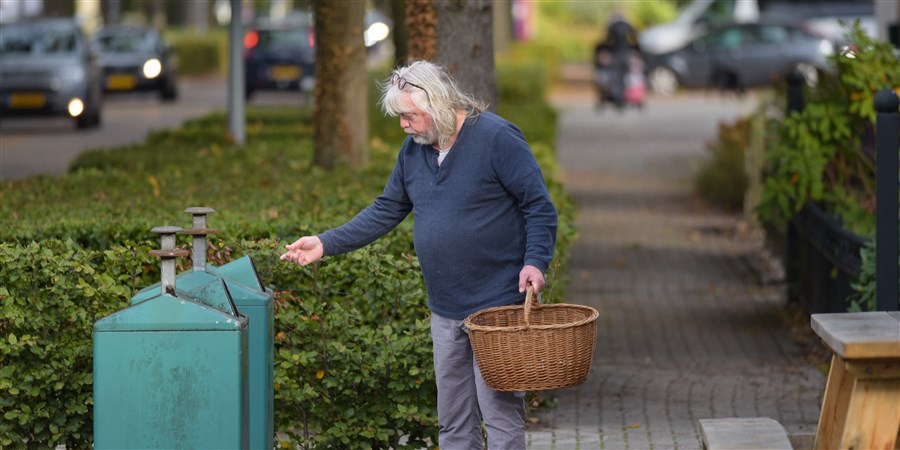
The three main types of household waste collected are residual waste, organic waste, wastepaper and cardboard. Municipalities in the Netherlands collected 149 kilograms of household residual waste per capita in 2024. In addition, 91 kilograms of organic waste and 40 kilograms of wastepaper and cardboard were collected per inhabitant. These three types of household waste combined accounted for 60 percent of the total, almost the same as in 2023.
Other types of household waste that were collected separately were glass, textiles and PMD waste (plastics, metals and cartons), and waste that residents took to the waste collection centre, such as bulky household waste, rubble and floor coverings. For a large proportion of these types of waste, slightly more waste per capita was collected than in 2023.
| Jaar | Residual household waste (kg) | Organic waste (gft) (kg) | Waste paper and cardboard (kg) | Othe types of household waste (kg) |
|---|---|---|---|---|
| 1994 | 237.81 | 80.25 | 46.68 | 113.21 |
| 1995 | 222.40 | 92.47 | 47.11 | 120.28 |
| 1996 | 224.48 | 94.17 | 54.22 | 124.70 |
| 1997 | 228.50 | 98.35 | 59.23 | 136.80 |
| 1998 | 233.16 | 95.05 | 64.65 | 140.70 |
| 1999 | 241.74 | 91.58 | 65.70 | 152.85 |
| 2000 | 248.04 | 91.86 | 64.44 | 162.11 |
| 2001 | 247.60 | 87.81 | 63.39 | 163.55 |
| 2002 | 244.57 | 87.32 | 62.50 | 167.30 |
| 2003 | 240.86 | 82.76 | 60.66 | 164.80 |
| 2004 | 241.93 | 86.53 | 63.15 | 169.33 |
| 2005 | 242.77 | 83.55 | 64.09 | 171.23 |
| 2006 | 242.52 | 79.35 | 66.19 | 173.12 |
| 2007 | 242.36 | 80.42 | 67.62 | 178.21 |
| 2008 | 240.57 | 78.57 | 68.52 | 173.81 |
| 2009 | 235.25 | 78.96 | 68.52 | 169.95 |
| 2010 | 226.33 | 75.73 | 64.25 | 168.24 |
| 2011 | 224.17 | 77.89 | 62.68 | 170.52 |
| 2012 | 218.93 | 77.87 | 62.68 | 161.93 |
| 2013 | 209.98 | 74.64 | 55.08 | 154.92 |
| 2014 | 206.11 | 80.00 | 54.33 | 157.79 |
| 2015 | 200.18 | 79.73 | 53.51 | 162.35 |
| 2016 | 189.69 | 82.57 | 52.75 | 171.24 |
| 2017 | 178.96 | 85.92 | 51.44 | 176.85 |
| 2018 | 171.24 | 86.57 | 49.69 | 185.34 |
| 2019 | 163.75 | 89.57 | 48.42 | 189.18 |
| 2020 | 163.75 | 96.22 | 48.46 | 206.59 |
| 2021* | 163.40 | 97.81 | 47.59 | 194.67 |
| 2022* | 151.28 | 88.69 | 43.21 | 176.13 |
| 2023* | 147.02 | 91.48 | 40.62 | 171.95 |
| 2024* | 149.50 | 91.48 | 39.75 | 178.20 |
| *provisional figures | ||||
The impact of urbanisation on waste
Municipalities generally have the power to determine how they collect waste. The degree of urbanisation of a municipality often plays a role in its waste management policy. Urban municipalities are more likely to have policies for separating waste than non-urban municipalities. This is one of the reasons why more residual waste is collected in urban municipalities than in less urban municipalities.More organic waste is collected in less urbanised areas than in (highly) urbanised areas. This is partly due to the methods of waste collection used, but also because people in these in these areas are more likely to have homes with gardens, which leads to more organic waste. In (highly) urbanised areas, organic waste is less likely to be collected separately.
Not all types of household waste are related to the degree of urbanisation within a municipality. The amount of glass collected in (highly) urban municipalities is approximately the same as in non-urbanised or lightly urbanised municipalities.
| Afvalsoort | Residual household waste (kg per capita) | Bulky household waste (kg per capita) | Organic waste (gft) (kg per capita) | Bulky garden waste (kg per capita) | Glass (kg per capita) |
|---|---|---|---|---|---|
| Not or lightly urbanised | 106.97 | 21.16 | 142.77 | 44.07 | 21.50 |
| Moderately urbanised | 123.59 | 22.64 | 111.50 | 32.32 | 20.86 |
| Highly or very highly urbanised | 177.95 | 32.18 | 60.38 | 10.98 | 17.56 |
| * provisional figures | |||||
Less waste containing asbestos collected
The amount of waste collected containing asbestos has gradually decreased in recent years. A total of 7.1 million kilograms of waste containing asbestos was collected in 2024. Asbestos is a hazardous substance, and its use was banned in 1993. This type of waste has been collected separately by municipalities since 1995, reaching a peak of 19 million kilograms in 1999.
This trend has not been seen in other, similar types of waste such as roofing. This type of waste is related to waste containing asbestos because it was often used in roofing. At total of 13 million kilograms of waste containing asbestos was collected in 2024, 1.6 kilograms more than the previous year. That was approximately the same as in 2020, when significantly more household waste was collected, due in part to an increase in construction and demolition work in and around homes.
| Jaar | Waste containing asbestos (million kg) | Roofing (million kg) |
|---|---|---|
| 1995 | 10.7 | |
| 1996 | 11.3 | |
| 1997 | 14.6 | |
| 1998 | 16.8 | |
| 1999 | 18.71 | 4.05 |
| 2000 | 18.20 | 4.27 |
| 2001 | 17.18 | 4.61 |
| 2002 | 17.45 | 4.44 |
| 2003 | 16.85 | 6.89 |
| 2004 | 14.96 | 9.94 |
| 2005 | 13.74 | 11.79 |
| 2006 | 11.38 | 12.94 |
| 2007 | 13.70 | 12.42 |
| 2008 | 12.01 | 10.17 |
| 2009 | 10.97 | 10.60 |
| 2010 | 10.64 | 11.40 |
| 2011 | 11.78 | 12.47 |
| 2012 | 10.32 | 10.51 |
| 2013 | 9.69 | 10.53 |
| 2014 | 9.57 | 10.40 |
| 2015 | 10.02 | 10.02 |
| 2016 | 11.34 | 10.10 |
| 2017 | 11.09 | 10.19 |
| 2018 | 12.20 | 11.58 |
| 2019 | 11.13 | 10.83 |
| 2020 | 11.17 | 13.49 |
| 2021 | 9.52 | 12.88 |
| 2022 | 7.66 | 12.36 |
| 2023 | 7.21 | 11.63 |
| 2024* | 7.12 | 13.23 |
| *provisional figures | ||
Sources
- StatLine - Municipal waste ; quantities