Carbon accounts

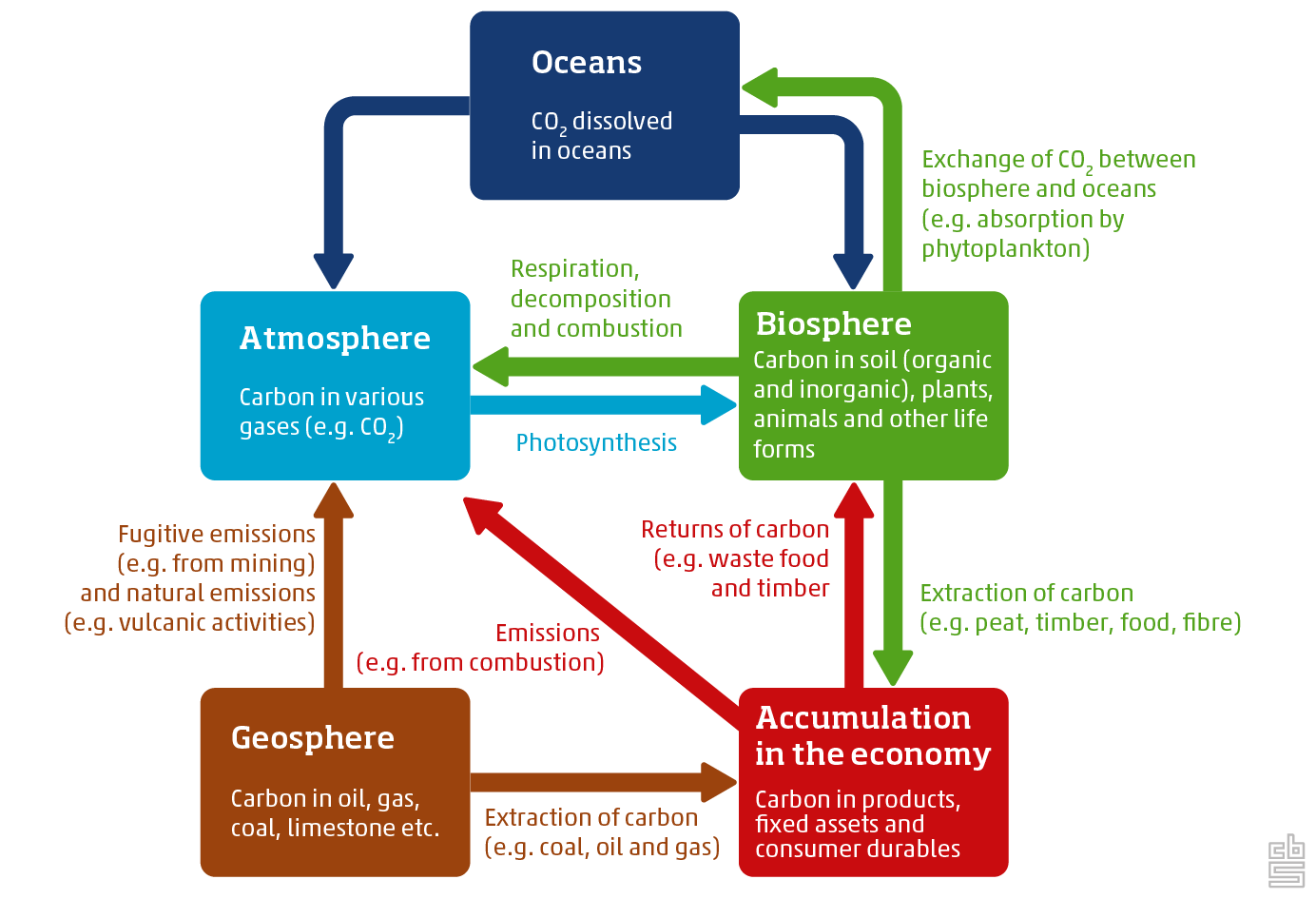
The carbon accounts track carbon flows and changes in carbon stocks resulting from both economic activities and natural processes. They cover carbon flows from the geosphere and biosphere to stocks within the economy, as well as carbon released back into the environment, for example through emissions to the atmosphere. The structure of the carbon accounts, shown in the figure below, provides a comprehensive and ecologically grounded overview of carbon accounting. It is based on the carbon cycle and explicitly considers the role of different carbon reservoirs.
Each sphere has opening and closing carbon stocks for a given accounting period, allowing changes in stocks to be identified as additions or reductions over time. The carbon accounts integrate several spheres, including the biosphere (e.g. vegetation and soil), the atmosphere (e.g. CO₂ and CH₄), the geosphere (e.g. natural gas and coal), and the economy (e.g. durable consumer goods and carbon stocks in buildings). Oceans are currently not included in these accounts.
By integrating these spheres, the carbon accounts provide a coherent overview of carbon stocks and flows. They also support the connection between different policy domains, including the circular economy, climate policy, economic policy, the biobased economy, and natural capital policy.